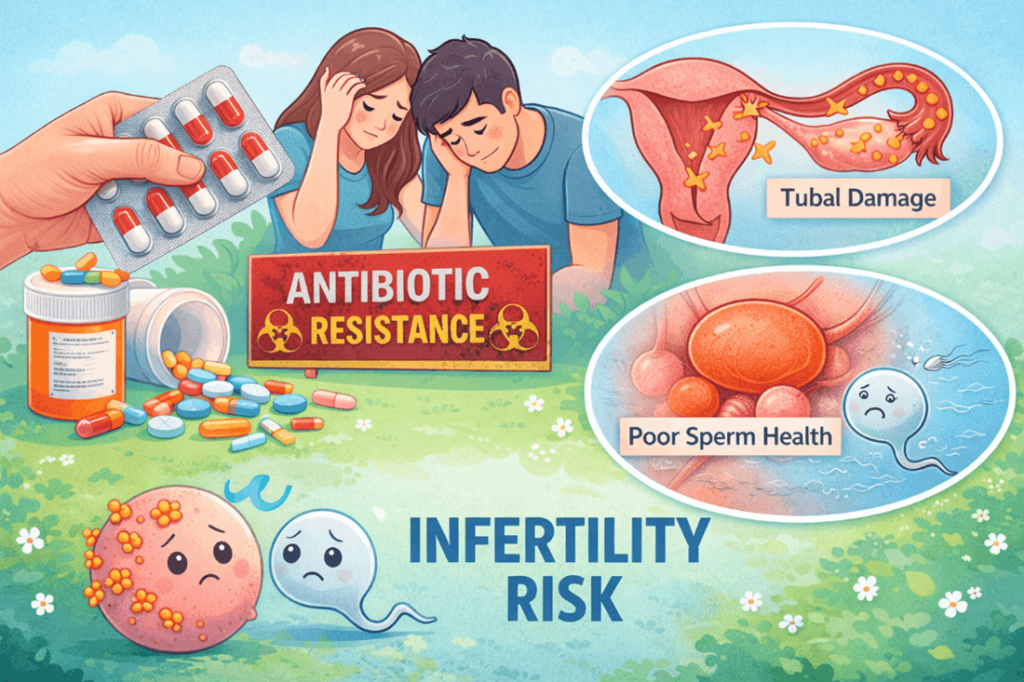
- 🦠Drug-resistant infections, often referred to as Antimicrobial Resistance (AMR) or Multi-Drug Resistant Organisms (MDROs), have a significant negative impact on both 👨 male and 👩⚕️ female fertility by making common reproductive infections difficult or impossible to treat.
- 💊The association of antibiotics with 👩⚕️ female infertility depends on the use and active ingredients.
- ⚠️ Early antibiotic discontinuation or incorrect medication use may reduce symptoms without curing the illness, resulting in silent damage to 🧬reproductive organs.
- 🧫 Antibiotics do not differentiate between “good” and “bad” microorganisms. Frequent use can disrupt the normal seminal and vaginal flora, making one more vulnerable to infections associated with infertility.
- 🤰 Preconception antibiotics exposure in females increases the risk of infertility, miscarriage, and congenital anomalies.
- 💊 Antibiotics like macrolides, sulfonamides, and trimethoprim increase the risk of infertility, spontaneous miscarriage, and congenital malformation, while beta-lactams and quinolones reduce the risk.
- 🧪Antibiotic resistance and chronic infections can reduce the success of assisted reproductive technologies like IVF, increasing 💔emotional and 💰financial strain.
✅ What to do?
- 🚫 Avoiding self-medication
- ✔️ Completing prescribed courses
- 🏥 Clinicians, pregnancy planners, and health care policymakers should be warranted for pregnancy needs and success.
- 🔬 Further clinical and mechanistic studies are required to explain their specific functions and cause effects.
📚 References
- Effect of preconception antibiotics exposure on female reproductive health and pregnancy outcomes: a systematic review and meta-analysis. Alemu, Bekalu Kassie et al. eClinicalMedicine, Volume 78, 102935
- Association between antibiotic exposure and the risk of infertility in women of childbearing age: A case-control study. Shanshan Shao, Weijun Pan et al.